
TOPICS
Local Norms
In a local norm, a student is compared to their peers in the school, subdistrict, or school district to which they belong. This scenario means the comparison group is closely representative of the local community and its unique demographic makeup. Most local norms compare a student to all students within the same grade or of the same age in the same school, subdistrict (a subset of the district [e.g., Title I schools vs. non-Title I schools]), or entire school district. This comparison represents the standing of a student in the local community. That is, the reference group is not limited in any way (e.g., only gifted students). “Local norms are often useful in conjunction with published norms, especially if the local population differs markedly from the population on which published national norms were based. In some cases, local norms may be used exclusively” (AERA, APA, & NCME, 2014, p. 196).
When generating a Local Norms Report, the composition of the local comparison group is important. First, the sample used to create a local norm should be reasonably large (i.e., 100 or more students) to ensure variability in responses, and second, it should adequately represent the local demographics. The local norm should also be inclusive and based on a universal assessment of all students within a grade, not just those who have been previously screened in any way (e.g., a rating scale or teacher recommendation). For example, if the goal is to have a local norm for Grade 2 students, then all Grade 2 students should be tested.
The composition of the local norm sample can have a large impact on a student’s Local Percentile Rank, Local Stanine, Local Standard Score, and Total Local Score. Consider a local norm sample based solely on a group of students already in a profoundly gifted program. A small number of these students will obtain a Below Average score (less than the 15th percentile; see Figure 1) in this sample; however, if these same students were compared to a local norm sample that included non-gifted students, they would all likely have a score in the Very Much Above Average range (above the 98th percentile). This difference in Local Percentile Rank occurs because Local Norm Scores are always relative to the other students in the sample. Therefore, it is strongly recommended that those interpreting these scores take note of who is included in the sample, especially when interpreting low scores on these tests.
Figure 1. Comparison of Score Types and Corresponding Categories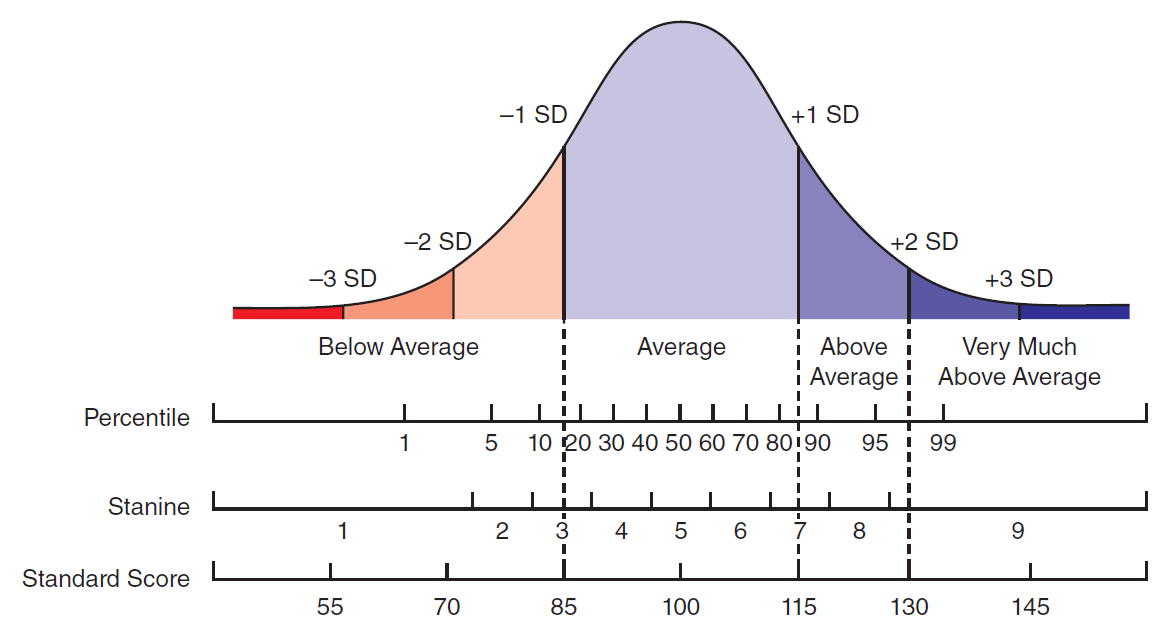
A student’s Local Norm Scores can be different when they are based on an individual school, subdistrict, or district comparison. School-level Local Norm Scores indicate what score a student achieved in relation to the local school’s population, while subdistrict-level Local Norm Scores indicate what score a student achieved in relation to the population of a group of schools. The group of schools selected to comprise a subdistrict-level local norm generally includes schools with a similar demographic makeup, such as Title I or non-Title I schools grouped to define a subdistrict-level Local Norm. District-level Local Norm Scores indicate what score a student achieved in relation to the local district’s population as a whole. When a school or group of schools is more diverse or does not have the same representation as the district, it can be more useful to examine the individual school or subdistrict norms to ensure a fair comparison of a student to their peers. In contexts where the school, subdistrict, or district’s population is diverse compared to the national population, local norms are useful for comparing a student’s score to one that more closely reflects students in the local community of learners.
The larger the local norm sample, the more precise the Local Percentile Rank, Local Stanine, Local Standard Score, and Total Local Score will be. Ideally, the minimum sample size should be about 100 students to calculate the Local Percentile Ranks, Local Stanines, Local Standard Scores, and Total Local Scores. When samples are smaller, it is recommended that the Local Rank Order be used, as it is unaffected by sample size.
The Naglieri General Ability Tests provide two types of local norm scores: Grade-Based Local Norm Scores and Age-Based Local Norm Scores. Each type of score is described in the following section.
Grade-Based Local Norm Scores
- Available for students in Kindergarten through Grade 9.
- Scores are computed by comparing a student to a sample of their grade-peers within the local sample. The local sample can be selected using any of the three levels of local norms:
- School-Level Local Norms: A comparison of grade-peers within a school.
- Subdistrict-Level Local Norms: A comparison of grade-peers within a group of schools in the district.
- District-Level Local Norms: A comparison of grade-peers within the district.
- For example, when School-Level Local Norms with Grade-Based scoring are selected, a student who is in Grade 4 is compared to all other Grade 4 students tested within the same school.
Age-Based Local Norm Scores
- Available for students in Kindergarten through Grade 9.
- Scores are first computed by comparing a student to a sample of their age-peers in a national sample, and then a comparison to their peers in the locally selected sample (see chapter 5, Development, for details). A student’s age is calculated based on their age in years and months at the time of test completion. The local sample can be selected using any of the three levels of local norms:
- School-Level Local Norms: A comparison of age-peers within a school.
- Subdistrict-Level Local Norms: A comparison of age-peers within a group of schools in the district.
- District-Level Local Norms: A comparison of age-peers within the district.
- For example, if District-Level Local Norms using Age-Based scoring are selected, a student who is 9 years, 7 months old is first compared to same-age peers (9 years, 7 months) in the national sample. That Age-Based score is then compared to all students in the same grade within the district to produce the final Local Age-Based Norm score.
Interpreting a Local Norms Report
References
American Educational Research Association, American Psychological Association, & National Council on Measurement in Education (Eds.). (2014). Standards for educational and psychological testing. American Educational Research Association.
- 25+ records: All Scoring Options
- 10-24 records: Local Rank Order/Local Percentile Rank
- <10 records: Local Rank Order